
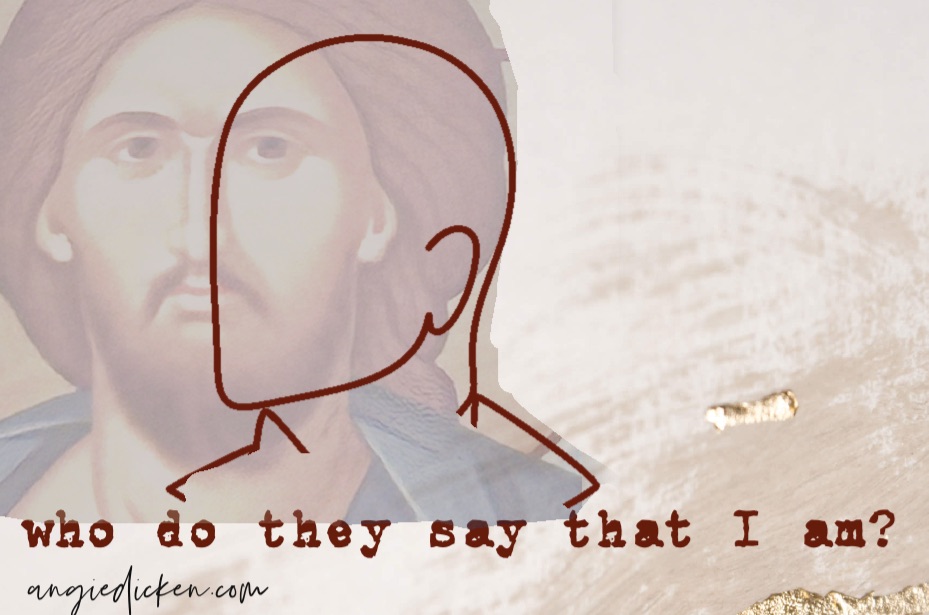

“Note that he is not asking them their own opinion. Rather, he asks the opinion of the people. Why? In order to contrast the opinion of the people with the disciples answer to the question “But who do you say that I am?” In this way, by the manner of his inquiry, they might be drawn gradually to a more sublime notion and not fall into the same common view as that of the multitude.” St. John Chrysostom
And the multitude didn’t know. Yet, their answers weren’t completely against goodness. They compared Jesus to good men they knew, but they obviously didn’t know who Christ was. Rumors among the multitude fell short. I think about how similar our society is these days…everyone infusing their own opinion, their own idea of goodness. Allowing quick words to amplify the noise of opinions.
Just because a notion tied with God fits my perspective, or it sounds good, doesn’t mean it’s accurate. My assumption could be distracting me from the Truth of Who God is. I could be crafting my own little god and not worshipping the actual God of the Universe at all.
I need to know Him like the disciples knew Him, not the multitude who claims a variety of things in a relativistic culture. I must seek the “sublime notion” of the disciples, the men whom Jesus entrusted to build His Church in perfect timing. And it is in His Church that I can find the Truth.
I am amazed how, later in the passage, after Peter declares Who He truly is, Christ tells the disciples not to tell anyone. He knew the plan. The timeline. I suspect He cared more about their understanding in that moment than His reputation among the multitude. His Church would be built by the men who knew the Truth, not by those stuck in the fray of opinions, no matter how loud they were, or how certain.
**The Scripture image is from the Catena App. This is a great way to explore the early Church Fathers’ Biblical commentary**
 angie dicken