Where I find peace

“God is everywhere present, filling all things.”

He is not a feeling I must conjure up in my mind and beg to be seen.

He is not just in the thin air as an invisible presence, or a dormant force waiting for me to nudge Him awake with my faith.

He is seen in the green, in the water, in the heartbeats of life; in the instinct of a gaggle; in the nurture of a mother and protection of a father.

In the sky’s breadth and the birdsong.

In the broken branches and the waiting limbs.

His logic and creativity and wisdom brings about everything, and in everything He is found.

I plunge deep in the heart of the woodland, and I skirt the reeds of the pond. My old flesh and secular mind want to be dazzled by God like magic because that’s what I’ve been told is supernatural.

Yet, that’s a manmade explanation. He is not on-demand, or a figmant of wishful thinking.

He is there. Here. Everywhere.

And in my heart, where turmoil is ever chipping at the Truth of His presence, He doesn’t speak with words, but His world.

And I find peace.

And He is.

The Best Years

My family will never be the same.

For fifteen years, I grew up three boys from single digits to adulthood. For fifteen years, I raised an infant to a young lady.

And for fifteen years, we really lived. Like full, boisterous, chaotic, loud, happy, sad, curious, hope-filled, life-filled, love-filled days and months and years.

Together.

On this plot of land.

Beneath this Midwest sky.

Surrounded by friends who’ve become family.

And now, we see the horizon growing closer and the path yawning far ahead and away.

As I look around this place in light of a sales sign coming soon—I am haunted by the sounds of my children—not as the teen and young adults of the present, but I hear the baby voices, their playful shouts. I hear all the life lived here. And I remember the way we were.

I’ve never had audible memories until now. Perhaps I am losing more than a home but my mind too??

I think it would be easier if they were still 8, 6, 4, and under a year. A move has its challenges with those ages, but the only bittersweetness to be felt was all my own. They were too young to know what they would miss, to think they might never see that friend again, that home.

Now, though, despite the excitement of a new adventure, grief has stricken most of us, and it keeps coming in waves.

Goodbyes are heavy on that horizon, and the anticipation builds up like a giant barricade. How will we ever pass through without pieces of us left behind?

We loved life here.

We lived life here.

I raised my family here. I grew roots in temporary soil…thinking it was permanent.

And those years just flew by.

And I just keep hearing them, almost seeing them, and I wonder at this backdrop of a life so full, how can we say goodbye for good?

A Note about March 25

I am in my 5th year of embracing Orthodoxy as an adult (I left the faith as a 19 year old…hardly an adult). One aspect of the faith that has secured my adoration for this walk, is the rhythm of the Church. We read purposeful Scripture all year long, every Sunday, every service. Sometimes, I may have not heard or sung a song before, but I know the words because they’ve been engraved on my heart in other contexts, and then my heart is full with savoring the words pouring from my lips.

Another beautiful rhythm is found in celebrating the Feast days centered on the events of Christ and His Church.

Today is the Feast of the Annunciation: the moment when Mary was approached by Gabriel and agreed to carry God within her—and from that moment on, she became Theotokos—God-bearer.

There are so many things I have learned about Mary these past 5 years, and I have untangled my misguided beliefs about the Mother of God. I’ve come to realize her blessedness has been muted by the noise of corruption, protest, and reform. Certainly the latter actions were well-intended by their initial warriors, but the chaos of the fight has tarnished her importance in many Christian circles.

On this day, when the one human of billions of humans was chosen by God to do the quiet thing of carrying a child within her, I must also remember to take care to partake in His invitation, even amid the noise. In this cacophonic, opinionated world, so much peace is lost, so much abiding with the Lord is lost. And so much attention to the goodness of God’s story, the saints, and His presence is drowned out by the voices, the shouts, the interpretations.

I love this quote below, about the quiet work of salvation as glimpsed in the Annunciation Scripture. Just as God’s voice is a quiet whisper, the quiet of salvation should be carefully considered, knowing so much can be lost to loudness, distraction, and noise:

“There is something strangely quiet about the work of salvation. I can think of few things quieter than the exchange between the Archangel Gabriel and the Virgin Mary. The entire cosmos was undergoing a radical transformation (God becoming man) while the entire interchange might have been whispered. No one noticed that anything was going on.” -Fr. Stephen Freeman

My greatest heartache for those I love most, those who have muted salvation within their hearts, is the power of noise and confusion—and the near impossibility to appreciate the quiet work they might experience, and the devastating reality of passing it by without noticing that anything was going on.


I was inspired to write this post by the latest blog by Fr. Stephen Freeman.

The Consequence of Mothering

My greatest goal with those colicky babies was to take away the pain. Rubbing their tummies, finding home remedies, even cutting out allergens from my own postpartum diet for weeks and weeks.

As they grew, taking away discomfort wasn’t so simple. Mothering became more of truth-speaking in the midst of the pain…hurt feelings from conflict with friends, sibling rivalry, not being chosen for that sought after team.

Truly, their struggle often stabbed me in the gut. Justice is rooted in my core, even in the small stuff. Instinctually, I strive for wrongs to be made right. Especially when it comes to my kids.

But now they are mostly grown, and my hope in taking away the pain gives way to the sobering fact: a mama doesn’t really have that power in the end. 

Recently, my child encountered one of the deepest hurts of their life so far, My previous tactics— pretending to be above their pain even if I was reeling on the inside, the effort of pouring out wisdom in the midst of their wounds, all the energy, secret tears, and constant empathy…all that surely has prepared me for this moment of facing sorrow on a grown up scale. 

If only. Not so much.

And as much as I want to push my kid along to find okayness again, I know the journey ahead far too well. It’s not an easy obstacle, and it’s definitely not quick. Loss and heartache cling relentlessly. And even as their mama, their biggest advocate, I have no power to tame it outright.

All I can do is wait in the shadows of their pain and be available when they need me.

And all the while, I am absorbing some of the grief too. Because, after twenty-three years of parenting, the greatest consequence of mothering is bearing their grief far more than my own. Yet, that inevitable burden is worth it. For my babies. The ones I love with all my worn-out heart.

Cunning Distraction

Lately, I have grown less patient with the neck bend. The lowered eyes disconnected, engrossed, and the completely mindless scrolling of those around me—especially my family members.

I once took a Cultural Geography class in college, and I recall the professor saying that we are at the peek of the computer age…that there really isn’t much more that can be done with the desktops of our time. Yet, nobody had experienced the smartphone, the platforms of social corruption—aka social media—nor the newest craze—AI.

I think we were in the glory days of technology back in the 20th century. It’s maybe taken a dangerous slip down a slope of steep proportions.

Scary stats are sprouting.

Consequences of our technological advances are beginning to emerge, and the social travesty of our constant worship of progress and pixels will surely become one for the history books. There is hope, as some are beginning to take steps toward limiting the exposure, especially in children. But too many adults are reckless, and as I look back, I am guilty by my own gifting of devices to my children at far too young an age. Sorrow overwhelms me knowing I have completely caved to indoctrinating my own with smartphone idolatry. The possession of a device fuels wildfire. Once the screen is touched, the person is never truly satiated again.

They will always go back for more.

And this is my greatest regret as a parent. I am certain, that conforming to the cultural norm of smartphones is the origin of my kids’ casted-off books and prayers and concentration and devotion.

That pesky scroll. And they are hooked. Rarely looking up in a roomful of people. Hardly ever craving a book. Never considering the soul they are shrinking.

Never considering the damage done.

But I do.

And I am completely undone by knowing it. This quote twists my gut because I am well acquainted with the cunning distraction:

“The most dreadful enemy created by post-industrial culture, the culture of information technology and the image, is cunning distraction. Swamped by millions of images and a host of different situations on television and in the media in general, people lose their peace of mind, their self-control, their powers of contemplation and reflection and turn outwards, becoming strangers to themselves, in a word mindless, impervious to the dictates of their intelligence.In the industrial era, people became consumers and slaves to things produced. In post-industrial society, they are also becoming consumers and slaves to images and information, which fill their lives.[…]I have realized that the destruction of man lies in the abundance of material goods, because it prevents him from experiencing the presence of God and appreciating His benevolence. If you want to take someone away from God, give him plenty of material goods. He will instantly forget Him forever.”  —Archimandrite Aimilianos, the Abbot of the Holy Monastery of Simonos Petras

Blatant

The other day, I was telling someone I respect that a semi-trucker was driving recklessly, and their response to me was, “Well, be careful around those, they probably don’t speak English.”

What in the world???

First of all, I had never, ever considered the ability to speak my language as an indicator of safe driving. But, I know the subtext of why they said it. It’s so much deeper and uglier than that.

I grow weary of being caught off guard by blatant prejudice in those I encounter. I grow sick of my internal turmoil, days after, wondering if I should have rebuked it more effectively. And the only effect I would be satisfied with, is a change of that person’s mind. Or rather, their heart.

Yet, I must stop myself from diving deep into the divide and rebuking their judgement in the way I would like (sharp words, shame, emotional lashing out). The dished out medicine only sickens my own heart, too.

As I consider how to deal with this unbelievable trend after 40+ years of living in this land, I’ve only come up with two appropriate postures in my every day life, especially when the words don’t come to me in the face of blatant remarks:

👉 my own activism in the broad sense.

And,

👉my constant prayer, in the heart-change sense (and it’s not I who can change a heart, so the prayer is a must, indeed).

So I continue to show kindness to the families of color that I work with and worship with. I continue to delight in the dialects and accents and cultural differences around me.

And I continue to pray—for life-giving words when conversation appalls, but mostly for the constant desires of my heart:

Lord have mercy on them,

and

Lord, have mercy on me, a sinner.

A Hand in Injustice

“We live in a world of emotional reactions, sharp words, and quick hatred. This is what immediately distances us from Christ. There is no need to fear and run from reality and pain. We need to “clothe them in Christ”. Sanctity is born during persecutions, blood, and fear. To give Christ preeminence means entering into this onerous reality together with Him, and to not let go of His hand.”—Metropolitan Luke Kovalenko

If I am not mindful, my intense desire for justice sours all goodness. Hatred is kindled, and more often than not, emotions and sharp words cast off Christ in my exchanges. I am another clanging cymbal in the madness. The reality and pain of the injustices become burdens too great to bear. And this reaction grows my shame—in face of heartache, my emotional behavior turns the attention to myself, not Justice at all.

But, the injustices are not unbeknown to Him, the God of the Universe, the God Who loves the whole world and demands we do the same. He is after all, the God Who hung in the fray of injustice. It was through the madness of man that He died a criminal’s death, being innocent all the same.

And so, this God, in the face of injustice, rose to the challenge, literally, and offers a different way than the madness. He offers Mercy.

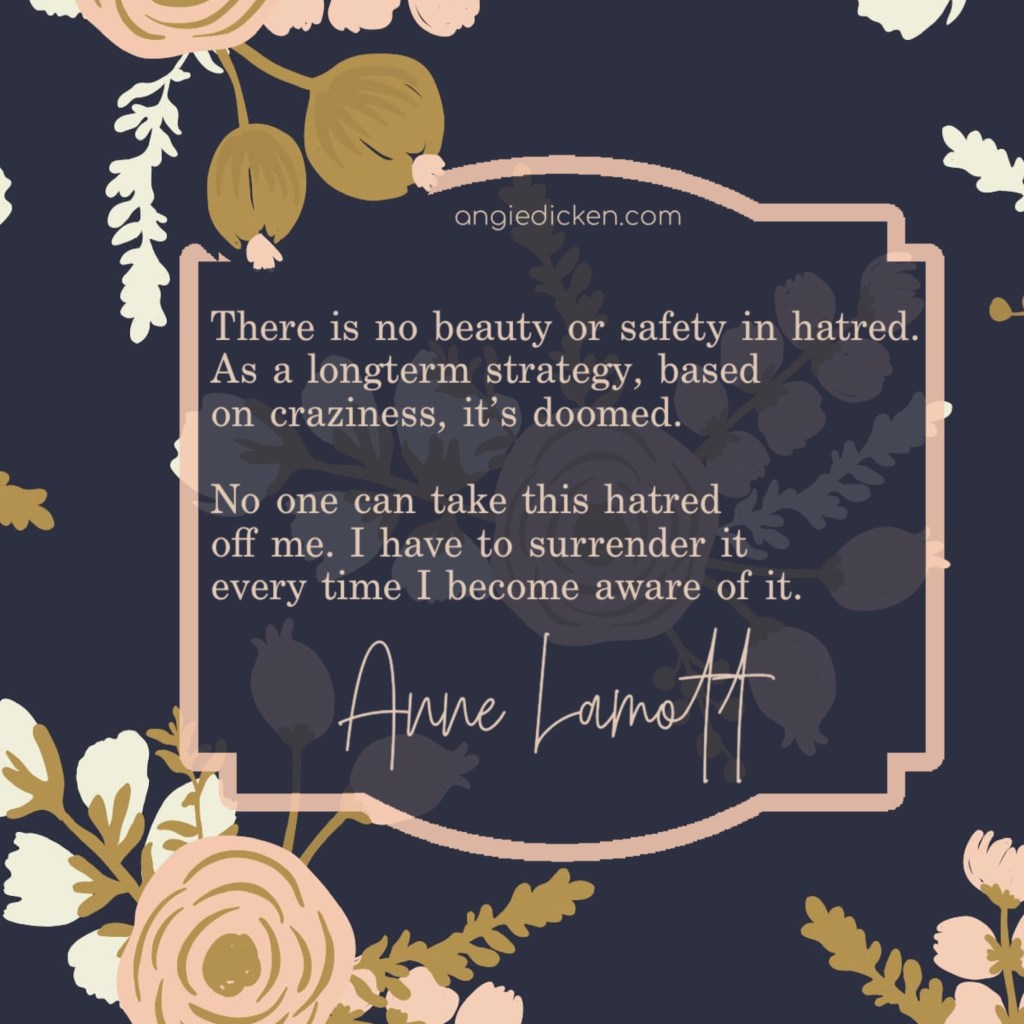
Angry words and hatred strip me naked of Christ, and there is nothing more dangerous to a soul. There is no Love exposed in tantrums.

The only way I can manage my sensitivities to injustices, is not by matching the world’s sharp exchanges, but holding onto the hand of Christ through this onerous reality, and allowing His way to be my own. For I know this to be true:

God’s love is perfect because God is perfect. It’s perfect because it doesn’t manifest itself in palaces and at feasts, but on the Cross; it reveals itself to us in suffering. We love God and others only in peaceful times and in satiety; and even then, mostly with our mouths. But God loves us always—especially in times of adversity and temptation. He loves us when we pray and when we sleep; when we go to church and when we go to the tavern; when we repent, and when we sin. He always loves us as a kind and merciful Father. In times of danger, in times of temptation, we run, we hide, we betray our brother, we lie, we even kill, just to survive. But God loves us to the end (cf. Jn. 13:1). In times of danger, He doesn’t abandon us, but goes ahead, carries our cross for us, is the first to ascend upon it, is the first to endure blows, and the first to die in the flesh so that we might live.” —Archimandrite Iachint Unciuleac

Using God.

Jesus is not a logo

He is not your poster child

He is not propaganda

Jesus is not one sided

He is not your cheerleader

He is not bought or sold

He’s not against any people

He is not prejudiced

He is not racist. Against His own creation??? How foolish, ridiculous, ignorant to even think so.

He does not turn a blind eye

He does not speak from both sides of his mouth 

He does not excuse bad behavior 

He is not your excuse

He is not a thing to be had

He is not yours

YOU ARE HIS.

Jesus is the Son of the Living God

He is the Image we all bear

He is Brother

Friend

Son

God

He hears

He sees 

He knows

He is Mystery

He is Love

He is Peace

And what you choose to celebrate, chant, sing, spout, believe, impose, despise, reject, manipulate, align yourself with…

is on you.

Not Him.

And stop thinking anything in this culture is justified because His name is mentioned.

Jesus is the God of the Universe Without beginning. without end, with or without us.

He’s not an object. He is God.

Stop Using Him.

Sign of Original Integrity

“A compassionate, loving, and merciful heart is a sign of restoration of human nature to its original integrity.

👉Such a heart bears the unity of all humanity and the cosmos.👈

Everything lives in a compassionate heart—people, animals, plants, and all organic and inorganic matter.

Thus, the believer becomes like God.

Like Christ, he is no longer separated from anything or anyone, because he bears all things within himself. Nothing is external and alien to him anymore, and he is not indifferent to anything anymore.

❤️He feels responsible for everyone and for everything that happens in humanity and in the universe. human nature to its original integrity.❤️…A believer who has acquired a compassionate heart resolutely sets himself up to serve his neighbors, with whom Christ identifies Himself.”

—Metropolitan Serafim Joanta, St. Isaac the Syrian

Post-Selfie World

The past several months, I have stepped away from my regular social media engagement. At first, I swore it off completely. But now, I occasionally get on there with blog posts or family updates.

Besides my brain being a little quieter, I’ve noticed that I don’t “think” in potential posts anymore. So sad that many of my treasured moments were sabotaged by my distracted mind forming the very best words and framing the very best photo, instead of being in the moment for the moment’s sake.

I’ve also noticed that I don’t take nearly as many photos of myself. It’s extremely obvious when I scroll through photos on my phone. And as I happen across the pics of my over-practiced poses, a needle of embarrassment pricks me. I turned the camera my way far too many times.

Honestly, it makes me a little sick to think about how trapped I was in the “selfie” world. And it makes me all the more conscious of my daughter towing the edge of it, and how I might help her.

I am not saying I will never take a selfie again, but I am fully aware of the direction it sends me if I were to grow the habit again.

What can I do, I wonder, to not fall for it? How can I help my daughter navigate the temptation?

It’s not real. It’s not healthy. And it’s sub-human, totally focused inward, surface, and empty. Humans are made for connection, not mirror reflections.

Self-focus, self-promoting, selfie, self-ick.

Stepping away from social media has been one way I’ve stepped out of myself too.